





By IDRAK PHARMA
Elemental magnesium is the amount of magnesium a supplement provides. Magnesium glycinate is the compound used to supply it. When comparing doses, use the magnesium amount in the Supplement Facts panel and check the serving size. A larger compound-weight number does not necessarily mean more elemental magnesium.
A recovery routine should be deliberate enough to understand. Before choosing a form, adding another capsule, or comparing two bottles, establish what the numbers mean. That is the starting point for a useful nutritional decision.
Elemental magnesium and magnesium glycinate describe different things
Magnesium glycinate combines magnesium with glycine. “Elemental magnesium” refers to the magnesium portion, rather than the full weight of that compound. The two terms describe the nutrient and its source, not competing supplements.
In the United States, the magnesium line in the Supplement Facts panel declares elemental magnesium. The source may appear alongside it, such as “as magnesium glycinate,” or elsewhere in the ingredient information. Start with that nutrient line, then read the form. NIH Office of Dietary Supplements: magnesium.
Consider a hypothetical label that reads “Magnesium 200 mg (as magnesium glycinate)” with a serving size of two capsules. It provides 200 mg of elemental magnesium per two-capsule serving. It does not provide 200 mg per capsule, and it does not mean the entire glycinate compound weighs only 200 mg.
A product name or front-label number can be useful for identifying a formula. It is not enough to compare daily intake. FDA labeling guidance centers the Supplement Facts declaration on the stated serving. FDA dietary supplement nutrition-labeling guidance.
Read a magnesium label in four steps
- Find the serving size. Is the panel describing one capsule, three capsules, a scoop, or another amount?
- Find the magnesium amount per serving. Use the elemental milligrams on that line when comparing products and adding your daily supplemental intake.
- Identify the source. Glycinate, citrate, oxide, and mixed-source formulas are different descriptions. If more than one source is listed, do not assume every milligram comes from glycinate.
- Read the directions and other ingredients. A comparison calculation is not permission to change the recommended serving or overlook ingredients that matter to you.
Keep the comparison on one basis. A three-capsule serving and a one-capsule serving can both supply the same elemental amount. Conversely, two bottles with the same capsule count can contain different numbers of labeled servings.
A real example: Rest Atlas product information
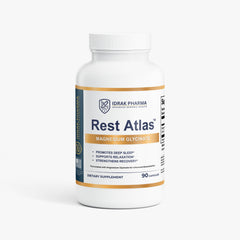
The current Rest Atlas™ product information specifies 275 mg of elemental magnesium from 2,500 mg of magnesium glycinate per three-capsule serving. The bottle contains 90 capsules, or 30 servings.
- 275 mg: the elemental magnesium supplied by the full serving.
- 2,500 mg: the stated magnesium glycinate source amount.
- Three capsules: the serving associated with those figures.
Do not add 275 mg and 2,500 mg together. They describe the same serving from different perspectives. Nor should you read the 275 mg figure as the amount in each capsule.
This distinction explains the formula more clearly than the largest number on a label could. It also gives you a consistent figure to use when reviewing other supplements in your routine.
Why a universal conversion percentage can mislead
A chemical calculation for a precisely defined compound is not a substitute for the finished supplement’s declared composition. A product may use a particular ingredient preparation or list multiple magnesium sources. The name on the front of the bottle does not supply all the information needed to reconstruct its elemental content.
Use the manufacturer’s declared elemental amount for that specific serving. If the source wording or amounts are unclear, request clarification before assuming that a generic online conversion describes the product. A discrepancy worth asking about is not, by itself, proof of superior absorption or poor quality.
Daily Value, daily requirement, and upper limit are not interchangeable
Daily Value is a labeling reference. The FDA’s magnesium Daily Value is 420 mg for adults and children age four and older. A label showing 50% Daily Value therefore supplies 210 mg. The percentage helps you compare nutrient amounts; it is not a personalized supplement prescription or a target that every capsule must meet. FDA Daily Values.
The Recommended Dietary Allowance concerns total intake. For nonpregnant adults, the magnesium RDA is 310–320 mg daily for women and 400–420 mg for men, depending on age. These totals include food and other sources. They do not mean everyone needs that amount from a supplement. Food and Nutrition Board: magnesium dietary reference intakes.
The adult supplemental upper limit is a separate safety reference. The Food and Nutrition Board established a 350 mg/day limit for magnesium from supplements and medications. It excludes magnesium naturally present in food and beverages and is not a recommended daily dose. A clinician may direct a different intake for an individual medical reason. Food and Nutrition Board: magnesium upper limit.
For example, 275 mg from one supplement plus 100 mg from another equals 375 mg of supplemental magnesium. That exceeds the adult upper limit even before considering magnesium-containing medicines. The arithmetic is simple, but it is easy to miss when one product is marketed for sleep and another as an electrolyte or multivitamin. Review the actual labels together rather than treating each product as a separate decision.
The label tells you the dose, not the outcome
Milligrams describe intake. They do not tell you how much a particular person absorbs or establish what that dose will accomplish. To judge a benefit claim, ask whether human research studied the same form, amount, population, duration, and outcome.
A 2025 randomized trial enrolled 155 adults reporting poor sleep. It tested magnesium bisglycinate supplying 250 mg of elemental magnesium daily for four weeks. Insomnia Severity Index scores improved by 3.9 points in the magnesium group and 2.3 points with placebo, a small between-group effect. That is useful human evidence for the preparation and conditions studied, not proof that every magnesium glycinate product produces the same result. Schuster and colleagues, 2025.
A 2026 systematic review found inconsistent sleep findings across 12 main randomized trials, with low-to-very-low certainty. The evidence does not establish a universally effective magnesium sleep dose or a superior form for sleep. The review did not support magnesium as a routine treatment for insomnia. Magnesium Supplementation for Sleep in Adults, 2026.
These studies did not test Rest Atlas as a finished product. A similar elemental amount does not make two formulations clinically equivalent. For the broader form comparison, read magnesium glycinate versus citrate.
When to check with a clinician or pharmacist
Kidney impairment can increase the risk of magnesium toxicity. Magnesium can also reduce the absorption of some antibiotics and oral bisphosphonates. Ask a clinician or pharmacist about suitability and spacing if you have kidney disease or take regular medication. High supplemental amounts can cause diarrhea, nausea, or abdominal cramping. NIH magnesium safety and interactions.
Follow the product directions. Rest Atlas directs adults to take three capsules once daily, or as directed by a healthcare professional, and not to exceed the recommended dose. Its product information advises medical consultation during pregnancy or nursing, for anyone under 18, and for people with a known medical condition. Persistent sleep problems deserve assessment rather than repeated dose increases.
Choose with the full serving in view
IDRAK’s Recovery Biology perspective starts with understanding the routine you are building. The useful choice is a formulation whose role, serving, and elemental amount you can explain, considered alongside food, sleep habits, medications, and any other supplements you use.
Explore Rest Atlas and its complete formula. If you are evaluating a coordinated approach, the Executive Performance System includes Rest Atlas, NeuroForge™, and Zen Mode™. Review each formula and its directions individually; a System is not a reason to skip interaction or total-intake checks.
Frequently asked questions
Does 2,500 mg of magnesium glycinate mean 2,500 mg of magnesium?
No. Compound weight and elemental magnesium are different figures. In the Rest Atlas example, the stated 2,500 mg source amount supplies 275 mg of elemental magnesium per three-capsule serving.
Should I compare milligrams per capsule or per serving?
Use the labeled serving as your starting point, then make sure you compare the same basis across products. Capsule count alone cannot tell you how much elemental magnesium a daily serving supplies.
Is a higher elemental dose always better?
No. A larger dose is not evidence of a better outcome. The relevant questions are what you need, what else you take, the product directions, and whether the evidence supports your intended use.
This article is educational and is not individualized medical advice. Dietary supplements are not intended to diagnose, treat, cure, or prevent disease.